Welding Wheels and Regulations & Safety – What Does the Law Say?
Welding wheels is a topic that has raised many questions among drivers for years. It is often said that cracked wheels should be replaced because repairs are either illegal or unsafe. Others argue that properly performed alloy wheel welding is completely safe and fully legal. So, what is the truth? Does Polish law allow wheel repairs through welding, and if so – under what conditions?
Below, we explain what the current regulations say, which technical standards govern the welding process, and when such repairs are permitted. This article is a practical guide – without myths or ambiguity, but with references to real regulations and safety principles.
Is Wheel Welding Legal in Poland?
Contrary to common belief, wheel welding in Poland is legal, provided the repair is carried out in accordance with applicable technical standards and safety rules. There is no regulation that directly prohibits welding aluminum or steel wheels. However, the method of repair must comply with general regulations concerning vehicle structural safety.
According to the Regulation of the Minister of Infrastructure of December 31, 2002, on the technical conditions of vehicles, any vehicle used on public roads must be technically sound, and all its components – including wheels – must ensure safe operation. This means that a welded wheel must not have a weakened structure or deformations affecting vehicle handling.
Additionally, welding aluminum components such as wheels should be performed by a qualified professional holding certification in accordance with PN-EN ISO 9606-2 (qualification of welders for aluminum and aluminum alloys). In practice, this means that legal alloy wheel welding requires:
- the use of an appropriate method (usually TIG or MIG),
- maintaining proper technological parameters according to repair documentation,
- performing leak testing and balancing after welding.
Therefore, if a workshop operates professionally, employs certified welders, and follows industry standards, wheel repair is fully legal and safe. Problems arise only when welding is carried out by unqualified individuals or with improper materials – in such cases, it may violate road safety regulations.
When Can You Weld a Wheel – and When Is It Not Allowed?
Not every wheel can be repaired by welding. Although modern technologies such as TIG aluminum welding allow precise repairs, there are situations where welding may be unsafe or not recommended. That is why a technical assessment is always performed before starting any repair.
When Welding Is Allowed
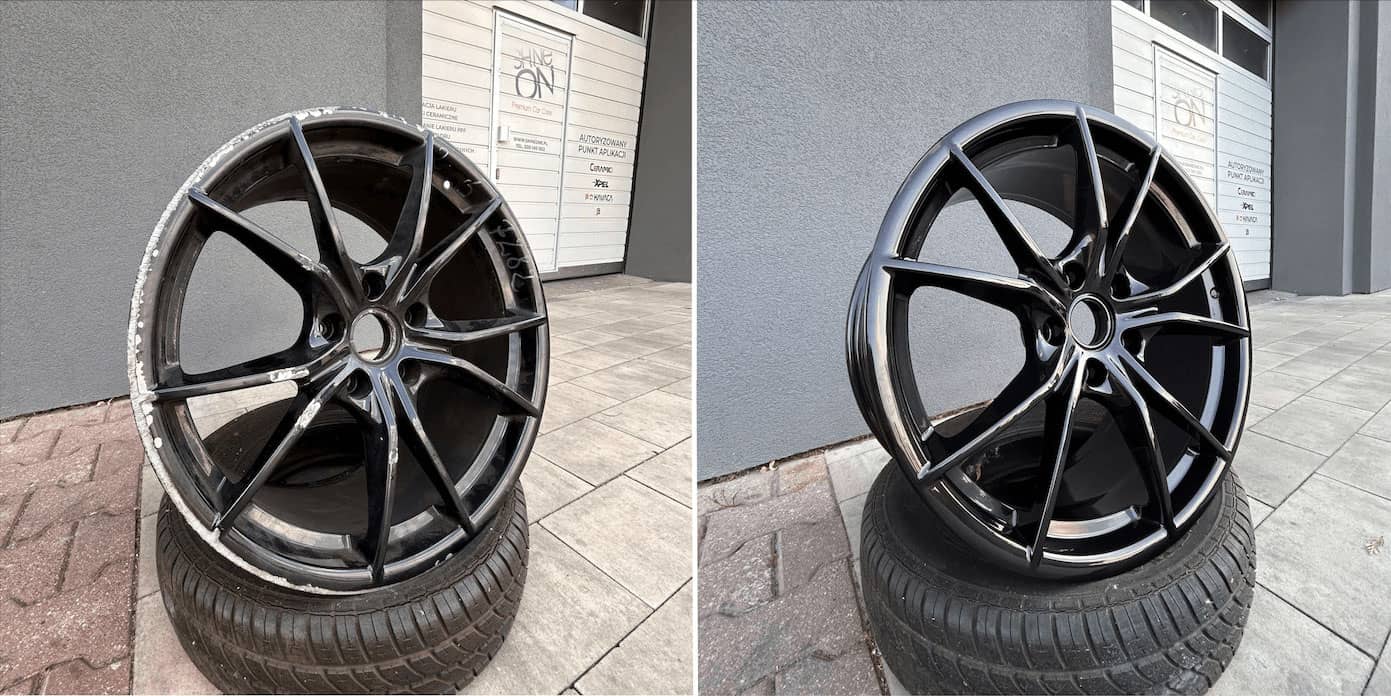
Alloy wheel welding is possible when the damage is local and does not compromise the structural integrity of the wheel.
Typical repairable cases include:
- cracks on the rim edge,
- chipped edges,
- minor material loss,
- slight deformations after straightening.
In such cases, welding can fully restore material strength, and after proper finishing and coating, the wheel can be as safe as a new one. However, each case should always be evaluated individually.
When Welding Is Not Recommended or Prohibited
There are also situations where welding is not safe or not allowed:
- cracks in the spokes (structural elements),
- major breakage of the wheel arm,
- deformation of the hub or center bore,
- cracks near mounting bolts,
- severe structural corrosion.
In these cases, welding may weaken the alloy and lead to further damage. Replacement is then strongly recommended. It is also worth noting that forged wheels often have a different material structure and may not be suitable for welding.
Pre-Welding Inspection Process
In professional workshops like FelgiLab.pl, each wheel undergoes:
- geometry and balance testing,
- visual inspection for cracks,
- leak and material thickness testing.
Only after this analysis can a specialist decide whether welding is safe.
Safety After Wheel Welding – Facts and Myths
Many drivers believe that a welded wheel will never regain its original strength. Others claim that modern welding techniques make repairs completely safe. The truth lies somewhere in between – it depends on the quality of the repair and the technology used.
Facts – When Welding Is Safe
Modern TIG welding allows welds with strength comparable to the original material, provided that:
- the correct filler material is used (e.g., AlMg5 or AlSi5),
- proper temperature and cleanliness are maintained,
- the weld is performed by a certified specialist.
Professional workshops also perform:
- leak testing,
- balancing checks,
- visual inspection for microcracks.
As a result, a repaired wheel can pass technical inspection and perform safely under normal use.
Myths – Common Misconceptions
- “Welded wheels always crack again” – false; failures occur only after poor-quality repairs.
- “Welded wheels fail inspection” – false if geometry and integrity are maintained.
- “Aluminum wheels cannot be welded” – false; they can, if done properly.
- “Welding weakens the wheel” – properly done TIG welding restores strength.
How to Recognize a Safely Repaired Wheel
A properly welded wheel should have:
- smooth, even welds without pores,
- no signs of overheating,
- proper balance after installation.
If the wheel does not vibrate and does not lose air, the repair was done correctly.
Safety Standards at FelgiLab.pl
At FelgiLab.pl, each wheel undergoes a three-stage quality control:
- optical inspection of welds,
- pressure leak testing,
- dynamic balancing.
This ensures full safety and compliance with TÜV and Polish standards.
What Does the Law Say About Welding Vehicle Components?
Polish law does not explicitly prohibit wheel welding but requires that any repair must maintain original functional and safety properties.
Key regulations include:
- Regulation of the Minister of Infrastructure (2002),
- Road Traffic Act (Article 66).
If a repair does not meet standards, the vehicle may fail inspection.
Standards for Welding Alloy Wheels
Professional repairs must comply with:
- PN-EN ISO 9606-2 (welder qualifications),
- PN-EN ISO 10042 (weld quality),
- PN-EN ISO 5817 (metal weld standards).
- Workshop and User Responsibility
The workshop is responsible for repair quality under warranty law.
The user should keep repair documentation as proof of legality.
Unauthorized Welding
“Garage” welding without testing may be considered a violation of road safety regulations and can lead to vehicle registration suspension.
Where to Weld Wheels Legally in Warsaw?
Before choosing a workshop, check if it:
- employs certified welders,
- uses professional TIG/MIG equipment,
- performs post-repair testing,
- provides written warranty.
FelgiLab.pl is one of the few workshops in Warsaw that meets all these requirements.
Why Choose FelgiLab.pl?
FelgiLab.pl combines experience, technology, and transparency.
We offer:
- repairs within 4–10 working days,
- 12-month warranty,
- full diagnostics and quality control,
- fixed pricing and free quotes based on photos.
- What Else Do We Offer?
In addition to welding, we provide:
- wheel straightening and CNC machining,
- powder coating and professional painting,
- corrosion and crack repair,
- OEM color matching.
If you are looking for safe and legal wheel welding in Warsaw, FelgiLab.pl is the right choice.
Call us at +48 514 716 916, email felgilab@gmail.com, or use the contact form – we will take care of your wheels professionally and safely.
Contact us
Have a question or want to get a quote? Fill out the form and we’ll get back to you as soon as possible.